

The automotive sector is under increasing scrutiny from the Health and Safety Executive (HSE), with isocyanate exposure now at the centre of a nationwide inspection campaign. Motor vehicle repair businesses across the UK are being targeted to ensure strict compliance with the Control of Substances Hazardous to Health (COSHH) Regulations.
Protect Your Business from the HSE Isocyanate Crackdown
Urgent HSE Warning: Isocyanate Inspection Campaign Targeting UK Automotive Businesses
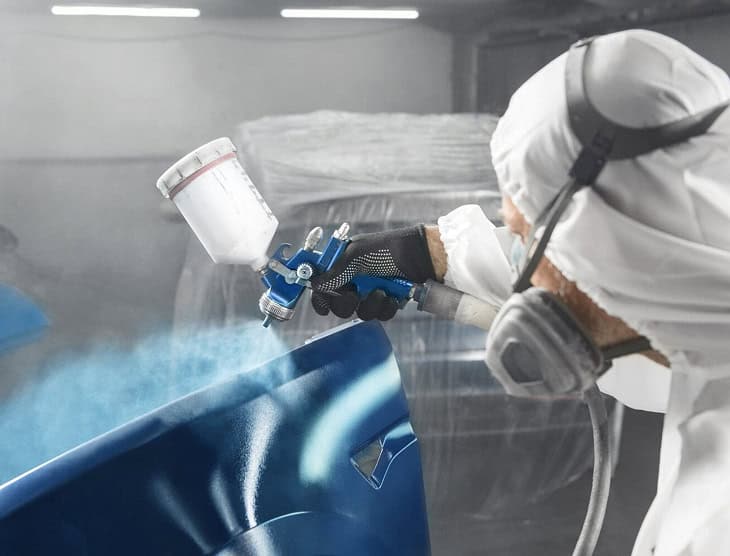
The Health and Safety Executive (HSE) has launched a targeted inspection campaign across Great Britain, focusing specifically on motor vehicle repair businesses using isocyanate-containing paints (often called ‘2K’ paints).
Isocyanates are the leading cause of occupational asthma in the UK, a life-changing disease that often forces skilled vehicle paint sprayers to leave the profession permanently. HSE inspectors are now visiting sites to ensure strict compliance with the COSHH Regulations 2002.
This is not a general advisory; it is a compliance crackdown. Failure to demonstrate adequate controls and monitoring is now resulting in immediate enforcement action, including improvement notices, prohibition notices, and potentially prosecution and unlimited fines.

The Immediate Threat & Your Legal Duty
To satisfy the HSE’s requirements and comply with COSHH, automotive businesses must demonstrate they have robust control measures in place and, crucially, monitor their effectiveness.
Under COSHH, you are legally required to provide:
- Health Surveillance for Occupational Asthma and Dermatitis: Regular medical screening by a competent occupational health provider to detect the early signs of sensitisation caused by isocyanates.
- Biological Monitoring: This is the HSE’s recommended method for verifying that your engineering controls (e.g., spray booths) and personal protective equipment (RPE) are functioning correctly and being used properly. Annual urine sampling for isocyanate metabolites is essential for all potentially exposed workers, particularly paint sprayers.
Conduct Risk Assessments and Implement Control Measures
Strict HSE regulations govern occupational health in the UK’s automotive sector to manage risks from machinery, hazardous substances, and driving.
Key hazards include respiratory issues from isocyanates in paints, dermatitis from chemicals, hand-arm vibration syndrome (HAVS) from tools, and stress. Employers must conduct risk assessments and implement control measures, such as health surveillance, training, and appropriate personal protective equipment (PPE), to ensure legal compliance and a safe, healthy working environment.

Occupational Hazards for the Automotive Industry

Chemical Hazards
Exposure to chemicals like isocyanates (in paints), solvents, engine oils, and battery acid can cause asthma, dermatitis, and other health problems

Physical Hazards
Risks from heavy machinery, power tools, working at height, moving vehicles, and electrical hazards can lead to serious injuries.

Mechanical Hazards
The use of power tools can lead to Hand Arm Vibration Syndrome (HAVS).

Mental Health Risks
Stress is a significant issue, affecting about one in two automotive workers, and employers must take steps to manage it.
Trusted by over 3,800 businesses





How LATUS Group Future-Proofs Your Automotive Business
LATUS Group provides the specialist occupational health expertise required to meet the HSE’s exact specifications, giving you confidence and legal compliance under the current inspection regime. We are experts in the automotive sector, offering a targeted approach that directly addresses the HSE’s three core inspection focus areas:

Specialist Isocyanate Health Surveillance
We implement a COSHH-compliant health surveillance programme that includes:
- Baseline & Annual Health Questionnaires: Focusing on respiratory and skin symptoms.
- Lung Function Testing: Spirometry is used to detect early changes in breathing capacity.
- Dermatitis Surveillance: Screening for signs of skin irritation or sensitisation.

Mandatory Biological Monitoring
We manage the entire process for isocyanate urine testing, ensuring samples are taken correctly (post-shift), analysed by UKAS-accredited laboratories, and results are interpreted against the HSE’s Biological Monitoring Guidance Value (BMGV).
A clear result provides evidence to the HSE that your control measures are effective. An elevated result provides a critical early warning to investigate and correct failures before they lead to irreversible health damage or legal action.

Proactive Risk Management & Beyond
While the HSE is currently focused on isocyanates, the automotive industry presents numerous other health risks that demand professional management. Our service ensures total compliance across your operation.
Ensure Compliance and Protect Your Workforce
Complete the form below and our team will be in touch the same day to arrange your consultation.
 Sector specific expertisePersonalised partnership tailored to your needsPackages suited to your industry requirementsBespoke account management modelFocus on Data, Sustainability & InnovationLargest Mobile Medical Fleet in UKOnly UK provider to offer Mobile Chest X-RayHundreds of Technicians working across UK & ROI

