

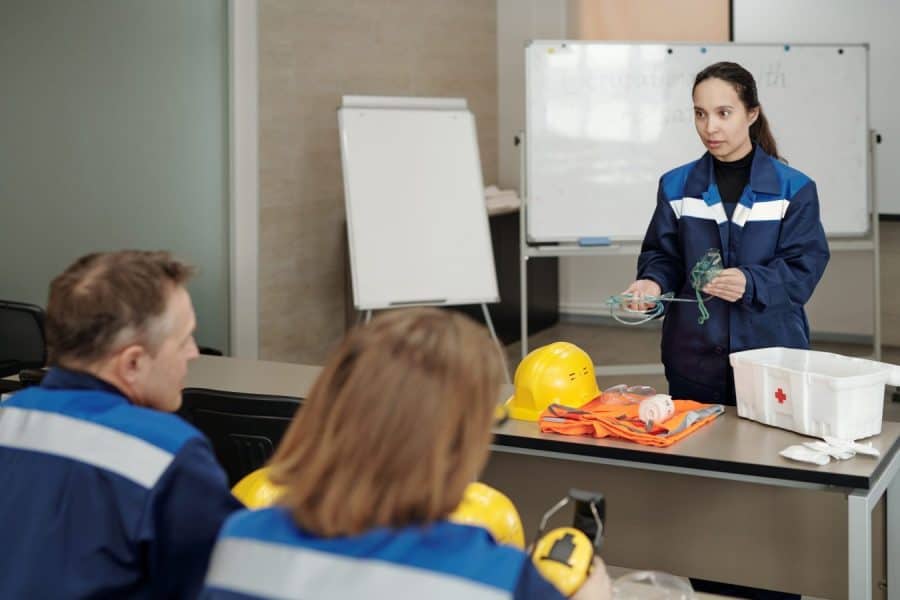
Respiratory protective equipment (RPE) is critical in many UK industries. However, simply issuing a mask is not enough. HSE face fit testing ensures that tight-fitting respirators provide the protection they are designed to deliver. Without proper testing, workers may be exposed to hazardous dusts, fumes, vapours or biological agents.
For UK employers, understanding current expectations is essential. In this guide, we explain what face fit testing involves, why it matters under UK law, and what businesses should expect from a compliant process.
Interested in speaking to an Occupational Health expert?
Complete our enquiry form and a member of the team will be in touch

Jack Latus – CEO
What Is HSE Face Fit Testing?
HSE face fit testing is the formal process of checking that a tight-fitting respirator forms an effective seal against the wearer’s face. If the seal is compromised, contaminated air can leak into the mask, reducing protection.
According to the Health and Safety Executive (HSE), face fit testing is required whenever employees use tight-fitting RPE as part of exposure control measures under the Control of Substances Hazardous to Health Regulations 2002 (COSHH).
In practice, testing confirms:
-
The mask model and size are suitable
-
The individual can achieve a proper seal
-
The respirator performs as intended
Importantly, a “one size fits all” approach does not work. Different face shapes require different models or sizes.
For official regulatory guidance, employers should refer to the HSE’s published standards on RPE: https://www.hse.gov.uk/respiratory-protective-equipment/fit-testing-basics.htm
Why Face Fit Testing Matters to Employers
Employers have a legal duty under the Health and Safety at Work etc. Act 1974 to protect employees from workplace risks. Therefore, if hazardous substances are present, suitable control measures must be implemented.
Under COSHH, RPE is often used as a last line of defence where exposure cannot be adequately controlled by elimination, substitution or engineering controls. However, RPE only works if it fits properly.
Without compliant HSE face fit testing, organisations risk:
-
Inadequate protection for employees
-
Enforcement action from HSE
-
Fines and prosecution
-
Increased sickness absence
-
Reputational damage
Furthermore, ineffective RPE can lead to long-term occupational illness, including respiratory disease. Consequently, testing is both a compliance requirement and a duty of care issue.
When Is Face Fit Testing Required?
Face fit testing is required whenever a worker uses tight-fitting RPE, including:
-
Disposable FFP2 or FFP3 masks
-
Half-mask respirators
-
Full-face respirators
Testing must be completed:
-
Before first use
-
When changing mask model or size
-
If the wearer’s facial features change significantly (e.g. weight change, facial surgery)
-
If there are concerns about fit
Additionally, employers should ensure workers are clean-shaven where masks rely on a facial seal. Even short stubble can compromise protection.
Types of Face Fit Testing
There are two recognised methods under HSE face fit testing guidance.
1. Qualitative Testing
This is a pass/fail test. The wearer is exposed to a harmless test solution with a distinctive taste or smell. If they detect it, the seal is inadequate.
Qualitative testing is typically suitable for disposable and half-mask respirators.
2. Quantitative Testing
This method uses specialist equipment to measure leakage into the mask and provides a numerical fit factor result.
Quantitative testing is generally used for:
-
Full-face masks
-
Higher-risk environments
-
Situations requiring measurable assurance
The appropriate method depends on risk assessment findings.
Face Fit Testing and COSHH Compliance
Under the Control of Substances Hazardous to Health Regulations 2002, employers must:
-
Assess exposure risks
-
Implement suitable controls
-
Ensure RPE is adequate and suitable
-
Provide information, instruction and training
Face fit testing sits within this framework. Therefore, it should form part of a broader compliance strategy, not a standalone exercise.
For example, in industries such as construction, manufacturing, engineering and waste management, exposure to silica dust, welding fumes or hazardous particulates makes proper RPE fit essential.
Businesses operating in higher-risk sectors may also benefit from reviewing wider occupational hygiene services to assess exposure levels before relying on RPE.
What Should Businesses Expect from a Compliant Provider?
When arranging HSE face fit testing, employers should expect:
-
Competent, trained testers
-
Clear documentation of results
-
Certificates for each employee
-
Advice on unsuitable masks
-
Record-keeping support
In addition, the provider should work alongside your wider health and safety framework. Testing should align with your risk assessments and health surveillance programme.
For organisations already undertaking health surveillance services, integrating face fit testing ensures consistency across compliance measures.
How Latus Group Supports Face Fit Testing
At Latus Group, face fit testing forms part of a comprehensive occupational health and compliance offering.
Importantly, testing can be delivered:
-
On-site via our national mobile teams
-
Alongside health surveillance programmes
-
As part of sector-specific compliance packages
For employers managing dust exposure, silica risks or airborne contaminants, combining testing with our occupational hygiene assessments ensures a joined-up approach.
Furthermore, our teams understand the regulatory expectations of HSE inspections. Therefore, documentation, certification and audit-readiness are built into the process.
If you are unsure whether RPE is sufficient in your workplace, our broader occupational health services for UK employers can help assess overall compliance requirements.
Common Employer Questions
Is face fit testing a legal requirement?
Yes. If tight-fitting RPE is required under a COSHH risk assessment, face fit testing is mandatory under HSE guidance.
How long does a face fit test last?
There is no fixed expiry date. However, retesting is required if mask type changes, facial features change, or fit concerns arise.
Does one test cover all masks?
No. Each different make, model or size requires a separate test.
Preparing for an HSE Inspection
HSE inspectors may request evidence of:
-
Risk assessments
-
COSHH assessments
-
RPE suitability
-
Face fit test records
-
Training records
Therefore, businesses should maintain organised documentation and ensure certificates are easily accessible.
For additional insight into regulatory expectations, employers can review the HSE’s inspection guidance here: https://www.hse.gov.uk/enforce/enforcementguide/
Being proactive not only reduces enforcement risk but also demonstrates a genuine commitment to worker wellbeing.
The Wider Workplace Health Perspective
While HSE face fit testing focuses on RPE performance, it should sit within a broader health strategy. Respiratory protection is often one control within a layered approach.
Therefore, forward-thinking employers integrate:
-
Occupational hygiene monitoring
-
Health surveillance
-
Risk assessment reviews
-
Clear worker training
This integrated approach reduces long-term risk and strengthens compliance culture.
Conclusion: Moving from Compliance to Confidence
Ultimately, HSE face fit testing is about ensuring that protective equipment does what it is supposed to do. However, it is also about protecting people, reducing liability and meeting UK legal obligations.
For employers, the key is consistency. Testing should be planned, documented and aligned with wider occupational health processes.
If your organisation uses tight-fitting RPE, now is the time to review whether your approach meets HSE expectations. A structured, compliant testing programme provides not just legal assurance, but operational confidence.
To discuss how face fit testing integrates with your wider occupational health strategy, speak to the team at Latus Group.
Interested in speaking to an Occupational Health expert?
Complete our enquiry form and a member of the team will be in touch
