


In today’s fast-paced working world, stress is often viewed as something to avoid at all costs. However, for UK employers and employees alike, that view is overly simplistic. While excessive pressure can damage health and performance, the right type of stress can, in fact, improve focus, motivation, and resilience at work.
Understanding how stress operates — and when it becomes harmful — is essential for building healthier, more productive workplaces.
What Is Stress in the Workplace?
Stress is the body’s natural response to pressure or demand. In the workplace, it can stem from deadlines, workload, change, responsibility, or uncertainty. Importantly, stress is not automatically negative. In practice, it exists on a continuum, ranging from too little stimulation to overwhelming pressure.
From an occupational health perspective, the key issue is not whether stress exists, but how individuals respond to it and whether adequate support is in place.
Eustress vs Distress: Understanding the Difference
Psychologist Hans Selye introduced the concept that stress falls into two broad categories: eustress and distress.
What is eustress?
Eustress is positive, short-term stress that motivates and energises us. It often appears during challenges such as learning a new skill, preparing for an important presentation, or taking on a promotion. As a result, it can drive performance, engagement, and personal development.
What is distress?
Distress, by contrast, occurs when pressure becomes prolonged or overwhelming. Ongoing high workloads, lack of control, or unresolved conflict can all lead to distress. Over time, this can contribute to anxiety, burnout, musculoskeletal issues, and long-term sickness absence.
Eustress is a healthy form of stress that improves motivation and performance, while distress is excessive or prolonged stress that harms mental and physical health. The difference lies in duration, intensity, and how well individuals feel supported to cope.

Above is a stress continuum where we can identify where stress becomes too little, optimum and too much. As you can see it is a fine line we need to cross to be over or under. So, what ways can distress, and eustress impact us? Below is a non-extensive list of some ways we can be affected by each of these stressors.
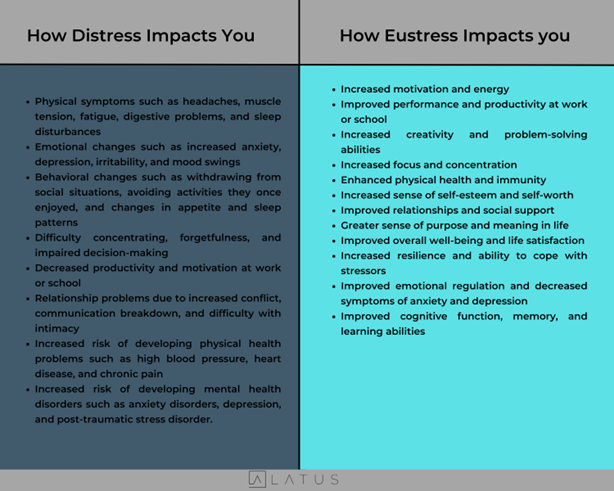
As you can see from this chart, there are many benefits of having eustress in your life compared to living in distress. But how do you know which state you are in? It all comes down to how you respond to these stressors.
Why the Stress Continuum Matters for Employers
From a UK employer perspective, recognising the stress continuum is critical. Too little demand can lead to disengagement and low productivity. However, too much pressure increases the risk of absenteeism, presenteeism, and mental health conditions.
According to guidance from the Health and Safety Executive, employers have a legal duty to manage work-related stress as part of their broader health and safety responsibilities. Failure to do so can expose organisations to increased absence costs, reduced morale, and potential legal risk.
Threats vs Challenges: How Mindset Shapes Stress
One practical way to understand stress responses is to consider whether situations are perceived as threats or challenges.
Threats — such as ongoing bullying, job insecurity, or serious illness — are more likely to trigger distress when support is limited. Challenges, on the other hand, may feel demanding but remain achievable, especially when individuals have the right resources.
Importantly, the same situation can feel very different depending on context, workload, and individual resilience. Therefore, stress management cannot rely on mindset alone; it must be supported by effective workplace systems.
Can Distress Become Eustress?
In some cases, yes. While not all stressors can or should be reframed, certain pressures can shift from distress to eustress when employees feel supported, listened to, and able to influence outcomes.
For example, following redundancy or organisational change, early occupational health input and clear communication can help individuals move from feeling overwhelmed to focusing on next steps. As a result, stress becomes more manageable and less harmful.
However, it is vital to recognise that chronic distress requires practical intervention, not just positive thinking.
The Physical Impact of Stress on Health
From a physiological standpoint, the body does not distinguish between “good” and “bad” stress. Both trigger the release of cortisol, a hormone designed to support short-term survival.
When cortisol levels remain elevated for prolonged periods, the effects can include:
-
Suppressed immune function
-
Disrupted sleep
-
Increased risk of metabolic conditions
-
Reduced concentration and memory
Over time, this can lead to increased sickness absence and reduced work ability. Consequently, early identification and support are essential.
Practical Ways to Support Healthy Stress Responses
While individual coping strategies are helpful, they work best when supported by organisational commitment. Common evidence-based approaches include:
-
Encouraging open conversations about mental health
-
Promoting good sleep hygiene and recovery
-
Supporting physical activity and movement
-
Providing access to professional support
-
Addressing workload, role clarity, and control
In practice, these measures help employees remain within an optimal performance zone, rather than tipping into harmful stress levels.
Legal and Wellbeing Responsibilities for UK Employers
Under the Health and Safety at Work etc. Act 1974, employers must take reasonably practicable steps to protect both physical and mental health at work. This includes assessing and managing psychosocial risks such as excessive pressure.
Guidance from the Health and Safety Executive reinforces the need for structured risk assessments, supportive management, and access to appropriate occupational health services.
How Latus Group Supports Stress Management at Work
Latus Group supports UK employers in managing stress through evidence-based occupational health services. These include:
-
Management referral assessments to support employees experiencing work-related pressure
-
Mental health and wellbeing services aligned with UK best practice
-
Health surveillance and risk assessments to support regulatory compliance
-
Absence management support to reduce long-term absence risk
By focusing on early intervention and practical recommendations, Latus Group helps employers protect wellbeing while maintaining productivity.
Conclusion: Using Stress Wisely in the Workplace
Stress is not inherently harmful. When managed well, it can drive performance, learning, and engagement. However, when left unchecked, it becomes a significant risk to health and organisational resilience.
For UK employers, the goal is not to eliminate stress entirely, but to create environments where pressure is balanced, support is accessible, and risks are identified early. With the right occupational health approach, stress can be managed effectively — benefiting both people and performance.

Interested in speaking to an Occupational Health expert?
Complete our enquiry form and a member of the team will be in touch
